Coin value guide · Nickels
Buffalo Nickel value: identification and what affects price
Buffalo Nickels turn up constantly in old jars and starter collections, often with the date worn away. Here's how to identify what you have and what actually affects its value.
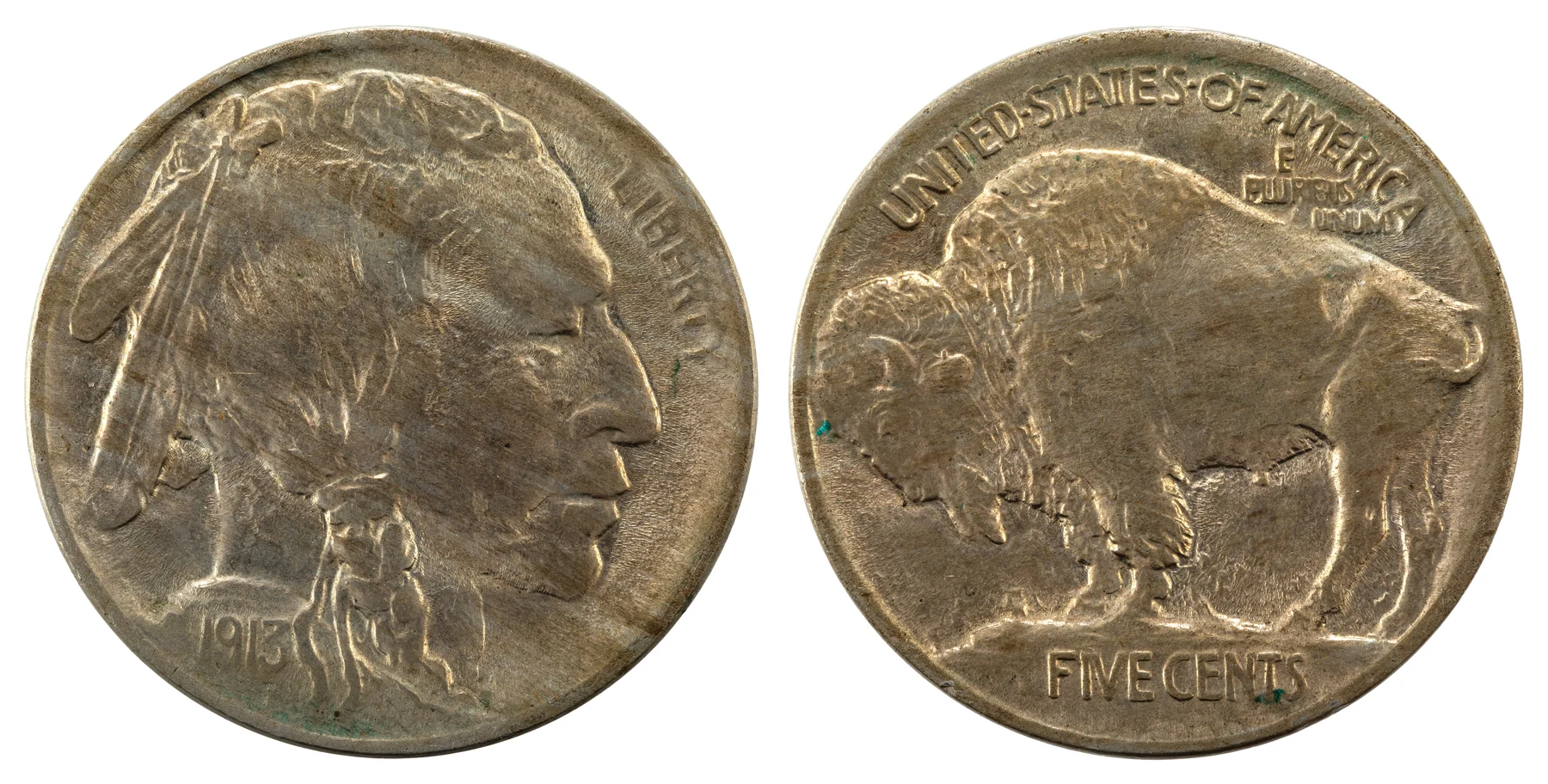
Identifying a Buffalo Nickel
The obverse shows a Native American portrait in profile; the reverse shows an American bison standing on a mound (1913 only) or a flat line (1913–1938). If the reverse instead shows Monticello, it's a later Jefferson nickel and follows a different value logic entirely.
Where to find the date and mintmark
The date sits on the obverse, on the raised ground line beneath the bust — the same area that wears down fastest with circulation, which is why so many surviving examples have a partial or missing date. The mintmark, when present, is on the reverse beneath "FIVE CENTS": a "D" for Denver, an "S" for San Francisco, and no letter for Philadelphia.
Why a full date changes everything
Because the date wears away so easily, a coin with a complete, legible date and mintmark is disproportionately more valuable than the same date with the numbers worn smooth. This is one of the few coin series where "can you actually read the date" is itself one of the biggest value questions, independent of the broader condition grade.
Common mistakes
- Trying to "bring out" a worn date. Any attempt to clean or enhance a worn date damages the surface further and reduces value.
- Assuming a dateless coin is worthless. Dateless Buffalo Nickels still typically carry modest value; they're just worth less than a full-date example of the same underlying coin.
- Misidentifying key-date varieties. The 1918/7-D overdate and 1937-D three-legged variety require close comparison against genuine examples — don't assume a similar-looking date is the rare variety without verification.
Next steps
For a handful of common-date Buffalo Nickels, a quick market estimate is usually enough. If you've found a full-date example of a scarcer year, or suspect a key-date variety, it's worth a closer look — see our coin authentication guide if you're unsure whether a suspected variety is genuine.
Why a dated professional assessment may differ from this guide
Distinguishing a genuine overdate or three-legged variety from a similar-looking common coin usually requires magnified, in-hand comparison against verified examples — something this guide can describe but not perform. A dated assessment accounts for the specific coin in front of it, not a general date-and-mintmark category.
For historical mintage figures and design background on the Buffalo Nickel series, the U.S. Mint (usmint.gov) and the Smithsonian's National Numismatic Collection (americanhistory.si.edu) publish general reference material. Mentioning these resources doesn't imply any endorsement of or affiliation with Coin Appraisers Guild.
Related guides
Keep exploring
Common questions
Buffalo Nickel values — common questions
What is a Buffalo Nickel?
The Buffalo Nickel (also called the Indian Head nickel) was minted from 1913 to 1938. The obverse shows a Native American portrait; the reverse shows an American bison. It was replaced by the Jefferson nickel starting in 1938.
Why are so many Buffalo Nickel dates worn smooth?
The date sits on a raised, exposed area of the design that wore down quickly with normal circulation, so a large share of surviving Buffalo Nickels have a partially or fully worn-away date. This is normal for the series and doesn't by itself indicate age or rarity beyond what the coin actually is.
Does a full, sharp date change the value much?
Yes, often significantly. A coin with a fully legible date and mintmark is worth more than the same date with a worn or missing date, since so many surviving examples lack one. For key dates especially, a full date can represent a large premium over a dateless or partial-date example.
Which Buffalo Nickels are worth the most?
Certain low-mintage dates — including 1913-S Type 2, 1918/7-D (an overdate variety), and 1937-D "three-legged" — are the series' best-known key dates and command significant premiums, especially in well-preserved condition.
What common mistakes should I avoid?
Don't clean a worn-date coin trying to make the date more legible — this damages the surface and lowers value further. Don't assume a dateless Buffalo Nickel is worthless; it typically still has modest value. And don't assume every 1918 or 1937 coin is the rare overdate or three-legged variety without a closer look.