Coin value guide · Dollars
Morgan Dollar value: identification and what affects price
One of America's most collected silver dollars, the Morgan Dollar shows up often in inherited collections. Here's how to read its date and mint, and what actually drives its value.
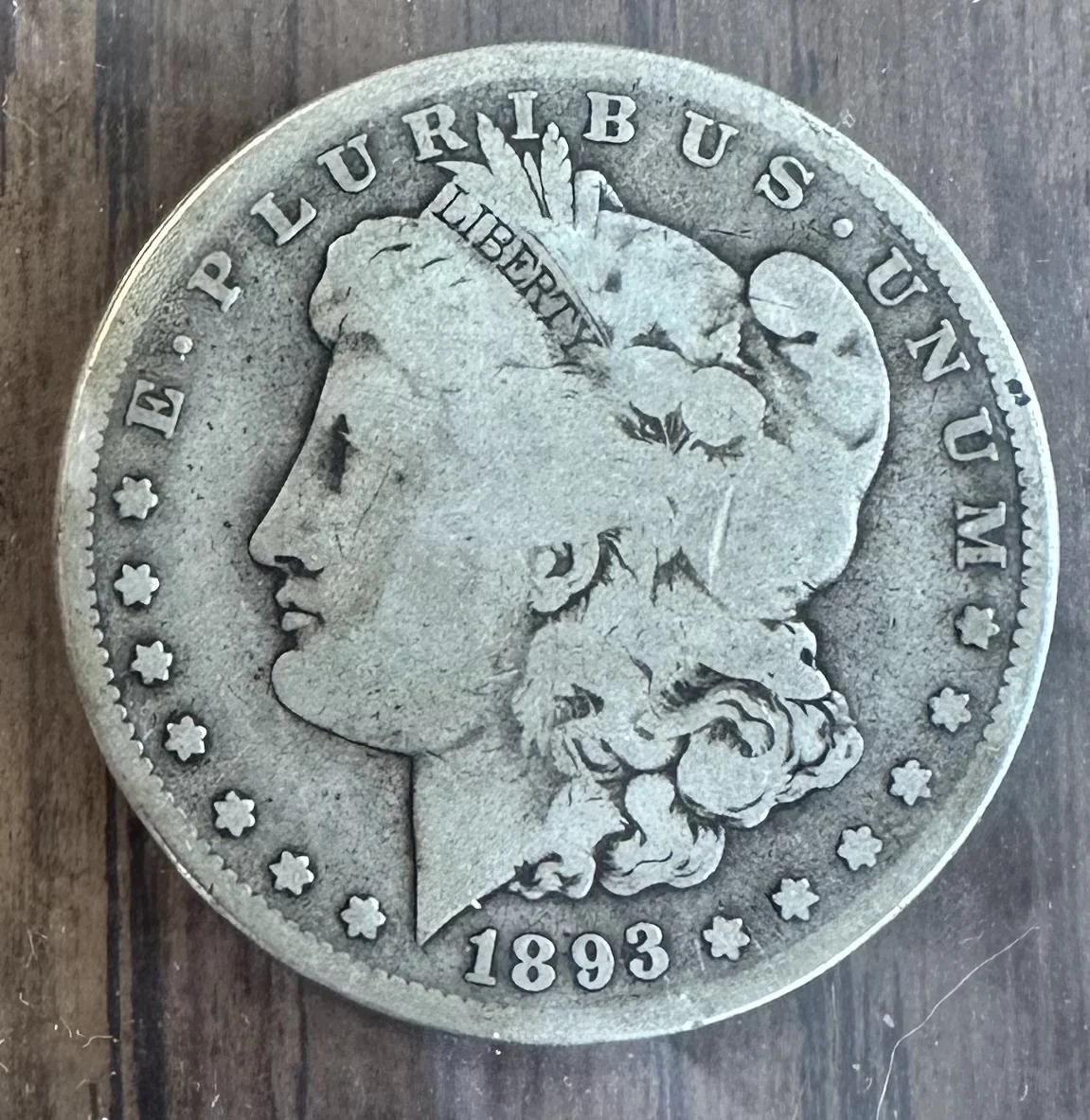
Identifying a Morgan Dollar
The obverse shows Lady Liberty in profile wearing a coronet, with "E PLURIBUS UNUM" above and the date below. The reverse shows an eagle with wings spread, holding an olive branch and arrows, encircled by a wreath. If your coin looks similar but shows a standing figure of Liberty with rays behind her on the reverse instead of an eagle in a wreath, it's likely a Peace Dollar (1921–1935), a related but separate series.
Where to find the date and mintmark
The date appears on the obverse, beneath Liberty's portrait. The mintmark, when present, is on the reverse, below the wreath and just above the "DO" in "DOLLAR": "O" for New Orleans, "S" for San Francisco, "CC" for Carson City, and "D" for Denver (1921 only). No mintmark means Philadelphia. Carson City and certain San Francisco issues, including 1893-S, are especially significant to value.
Why condition and luster matter
Morgan Dollars are graded in part on "luster" — the original mint shine still visible on the surface — along with strike quality and the amount of wear on Liberty's hair and the eagle's breast feathers. Because enormous quantities were stored in bank and mint bags for decades, many Morgan Dollars survive in exceptional condition, which makes condition an especially significant value factor even for common dates.
Common mistakes
- Cleaning the coin. Original luster is one of the most valuable characteristics a Morgan Dollar can have, and cleaning destroys it visibly and permanently.
- Assuming a worn common date has no value. Silver content sets a floor value regardless of condition.
- Assuming mintmark alone determines rarity. Some "S" and "CC" dates are common; some Philadelphia dates are scarce. The full date-and-mintmark combination matters.
Next steps
For a small number of Morgan Dollars, a quick market estimate from a dealer familiar with the series is usually a reasonable starting point. For a larger holding, or if you've identified a potential key date like 1893-S, a formal appraisal or a closer look from a specialist is worth considering — see our coin collection appraisal guide.
Why a dated professional assessment may differ from this guide
Grading a Morgan Dollar accurately often depends on subtle differences in luster and strike that are hard to judge from a photo, and the coin's silver-content baseline shifts with the metals market day to day. A dated, in-hand assessment accounts for both in a way a general guide can't.
For historical mintage figures and design background on the Morgan Dollar series, the U.S. Mint (usmint.gov) and the Smithsonian's National Numismatic Collection (americanhistory.si.edu) publish general reference material. Mentioning these resources doesn't imply any endorsement of or affiliation with Coin Appraisers Guild.
Related guides
Keep exploring
Common questions
Morgan Dollar values — common questions
What is a Morgan Dollar?
The Morgan Dollar is a 90% silver U.S. dollar coin minted from 1878 to 1904, and again in 1921. It's named for its designer, George T. Morgan, and is one of the most widely collected historic U.S. coin series, in part because so many were struck and saved in original mint bags.
Which Morgan Dollars are worth the most?
Low-mintage and branch-mint issues — most famously 1893-S, along with several other San Francisco and Carson City dates in high condition — carry the largest premiums. Because so many Morgan Dollars survive in well-preserved condition, exceptional condition alone can also create meaningful premiums even on otherwise common dates.
Does silver content set a minimum value?
Yes — because Morgan Dollars are 90% silver, even the most common, heavily worn examples generally carry value tied to their silver content, which moves with the metals market. Collector demand for date, mintmark, and condition sits on top of that baseline.
What common mistakes should I avoid?
Don't clean a Morgan Dollar — original surface "luster" is a major value factor, and cleaning destroys it permanently, often in a way that's obvious to any buyer. Don't assume a worn common date is worthless either; silver content sets a floor. And don't assume every San Francisco or Carson City coin is automatically rare — mintmark alone isn't the full picture.
Why might a professional assessment differ from what a guide suggests?
Morgan Dollar values are unusually sensitive to condition grade, and distinguishing between adjacent grades often requires in-hand examination under proper lighting — something a general guide can't replicate. Current silver spot price at the time of assessment also affects the baseline value.