Coin value guide · Cents
Wheat Penny value: identification and what affects price
The Lincoln Wheat cent (1909–1958) is one of the most commonly found coins in inherited jars and starter collections. Here's how to identify what you have and what actually drives its value.
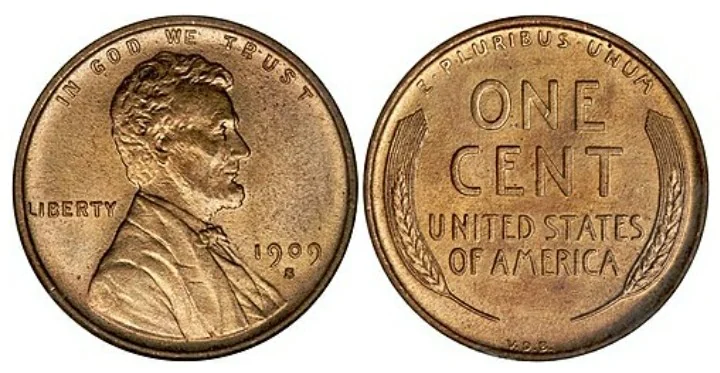
Identifying a Wheat Penny
Look at the reverse (back) of the coin: two wheat stalks framing the words "ONE CENT" mean it's a Wheat Penny, minted between 1909 and 1958. The obverse shows Lincoln's portrait with the year below. If the reverse instead shows the Lincoln Memorial, it's a later cent (1959–2008) and follows different value patterns.
Where to find the date and mintmark
The date sits directly below Lincoln's portrait on the obverse. The mintmark, if present, sits just below the date and to the right: a small "D" means Denver, an "S" means San Francisco, and no letter means Philadelphia. On 1909 cents, look just beneath the date for tiny initials "V.D.B." — their presence or absence, combined with the mintmark, is what separates the common 1909 issue from the scarce 1909-S VDB.
Why condition matters as much as date
Even among common dates, a well-struck, minimally worn example is worth more than a heavily worn one. Collectors look at how much detail remains on Lincoln's portrait and the wheat stalks, whether the coin retains original color or has been cleaned, and whether the strike is sharp or weak. For key dates especially, the difference between a worn example and a well-preserved one can be substantial.
Common mistakes
- Cleaning the coin. This is the single most common way people accidentally reduce a Wheat Penny's value.
- Assuming every old coin is rare. Most early Wheat Pennies were minted in huge quantities and remain common today.
- Overlooking the mintmark. The same date can be common in one mint and scarce in another — always check for a mintmark before assuming a coin's value.
- Treating 1943 steel cents as valuable errors. Steel cents from 1943 are normal wartime production, not the rare 1943 copper error, which is a different and far scarcer thing entirely.
Next steps
If your Wheat Pennies are mostly common dates in circulated condition, a quick market estimate from a local dealer is usually enough. If you've found a potential key date, an unusual variety, or a large accumulation, it's worth a closer look before deciding anything — see our coin collection appraisal guide for what that process involves.
Why a dated professional assessment may differ from this guide
This guide describes general identification points and value factors. It can't account for a specific coin's actual surface condition, strike sharpness, or subtle doubled-die and error varieties, which is exactly what an in-hand or high-resolution photographic assessment is for. Treat this as a starting point for identification, not a substitute for that closer look.
For background on U.S. one-cent coin design history and mintage figures, the U.S. Mint (usmint.gov) and the Smithsonian's National Numismatic Collection (americanhistory.si.edu) publish general reference material. Mentioning these resources doesn't imply any endorsement of or affiliation with Coin Appraisers Guild.
Related guides
Keep exploring
Common questions
Wheat Penny values — common questions
What is a Wheat Penny?
A Wheat Penny is a Lincoln cent minted from 1909 to 1958, named for the two wheat stalks on the reverse. It was replaced by the Lincoln Memorial reverse design in 1959. Most Wheat Pennies found in circulation-era jars and collections are common dates worth modestly above face value.
Which Wheat Pennies are worth the most?
Key dates and low-mintage varieties command the largest premiums — most notably 1909-S VDB, 1914-D, and 1922 "plain" (no mintmark) examples, along with certain doubled-die varieties. Condition matters enormously even among these: a well-preserved example of a key date is worth far more than a heavily worn one.
Are all Wheat Pennies from the early 1900s valuable?
No. Many early-date Wheat Pennies were minted in the hundreds of millions and remain common in worn condition. Value depends on the specific date-and-mintmark combination and condition together, not the coin's age alone.
What common mistakes should I avoid?
Don't clean a Wheat Penny to make the date more legible or the surface shinier — cleaning typically lowers value. Don't assume every 1943 cent is a rare copper error; the vast majority of 1943 cents are steel, which is normal, not a mistake. And don't rely on age alone as a proxy for value.
Why might a professional assessment differ from what a guide suggests?
Guides describe general value ranges for a date and mintmark; an in-hand assessment accounts for the specific coin's actual condition, strike quality, and any doubling or error varieties a photo or written description can miss. That's why a dated, in-person opinion can land meaningfully above or below what a general guide implies.